Construction Crisis in Japan: How Japanese Bathrooms Are Made
From unit baths to custom tile, here's how Japanese bathrooms are built - and what we'd recommend for your renovation.
When most people imagine renovating a home in Japan, they think about timber ceilings, shoji screens, beautiful kitchens, and open-plan living spaces.
Few expect the bathroom to become one of the biggest design decisions of the entire project.
For buyers from Europe, North America, or Australia, the typical Japanese bathroom often comes as a surprise. Instead of a fully tiled room with custom waterproofing, stone floors, and bespoke joinery, the overwhelming majority of Japanese homes use what is known as a unit bath.
At first glance, it can feel like a compromise.
But after renovating numerous properties throughout Tokyo, we've learned that the story is far more complicated.
The recent construction disruption in Japan also highlighted just how dependent the industry has become on these prefabricated systems. When shortages affected production, thousands of projects suddenly had to rethink how bathrooms were built.
As supply chains have now largely returned to normal, it's a good opportunity to explain why Japanese bathrooms are built this way, what alternatives exist, and where we believe your renovation budget is best spent.
What Is a Unit Bath?
A Japanese unit bath is a prefabricated bathroom manufactured almost entirely inside a factory.
Instead of building the room piece by piece on-site, manufacturers produce the floor, walls, ceiling, bathtub, plumbing connections and waterproofing as one integrated system.
These components are then transported to the property and assembled almost like a puzzle.
Everything has been engineered to fit together precisely.
For builders, this offers several major advantages.
- Installation is fast.
- Waterproofing is extremely reliable.
- Quality is consistent.
- Future maintenance is relatively simple.
- Replacement parts remain available for years.
For developers building hundreds of apartments every year, those benefits are impossible to ignore.
Convenience wins.
Why Does Japan Love Unit Baths?
Many people assume Japan simply prefers plastic bathrooms.
That isn't really true.
Japan simply became incredibly good at industrialising construction.
Building homes quickly while maintaining high quality has always been a priority, particularly in dense cities like Tokyo where labour costs are high and projects operate on tight schedules.
Instead of waterproofing every bathroom individually with multiple trades working together over several days, a contractor can install a complete factory-built bathroom in a fraction of the time.
For apartments especially, this dramatically reduces construction risk.
If every connection has already been tested inside a factory, there are simply fewer opportunities for mistakes.
The Construction Crisis That Changed Everything
Earlier this year, Japan's construction industry experienced something unusual.
Supply chains for petrochemical products became heavily disrupted following geopolitical tensions affecting the Middle East.
One of the most important materials affected was naphtha, a petroleum-based feedstock used to manufacture plastics, resins, adhesives, insulation and countless construction products.
That includes many of the components found inside Japanese unit baths.
Suddenly, products that had always been readily available became difficult to obtain.
Some major manufacturers temporarily restricted orders or delayed deliveries while production adjusted to material shortages.
Projects across Japan were pushed back.
For the first time in many years, contractors couldn't simply order another unit bath.
The standard solution had disappeared.
Fortunately, production has now largely returned to normal, supply chains have stabilised, and manufacturers are once again delivering bathrooms without the widespread delays experienced during the disruption.
But the shortage exposed something interesting.
Builders Suddenly Started Looking at Tile
One of the most fascinating things about the shortage wasn't simply that bathrooms became difficult to buy.
It was watching how builders reacted.
Normally, a contractor might never even suggest a fully tiled bathroom.
Not because tiled bathrooms are worse.
Not because clients don't want them.
Simply because the unit bath has become the default option.
When unit baths temporarily became unavailable, people suddenly started asking different questions.
"What about tiles?"
"What about microcement?"
"What about building the bathroom traditionally?"
The shortage reminded everyone that alternatives still exist, but the shortage wasnt long enough for people actually realizing these "creative" ideas.
For a brief period, builders had to think outside the standard system.
Personally, I Love Tiled Bathrooms
If you've followed our renovations, you'll probably know this already.
I love a beautifully designed tiled bathroom.
Natural stone.
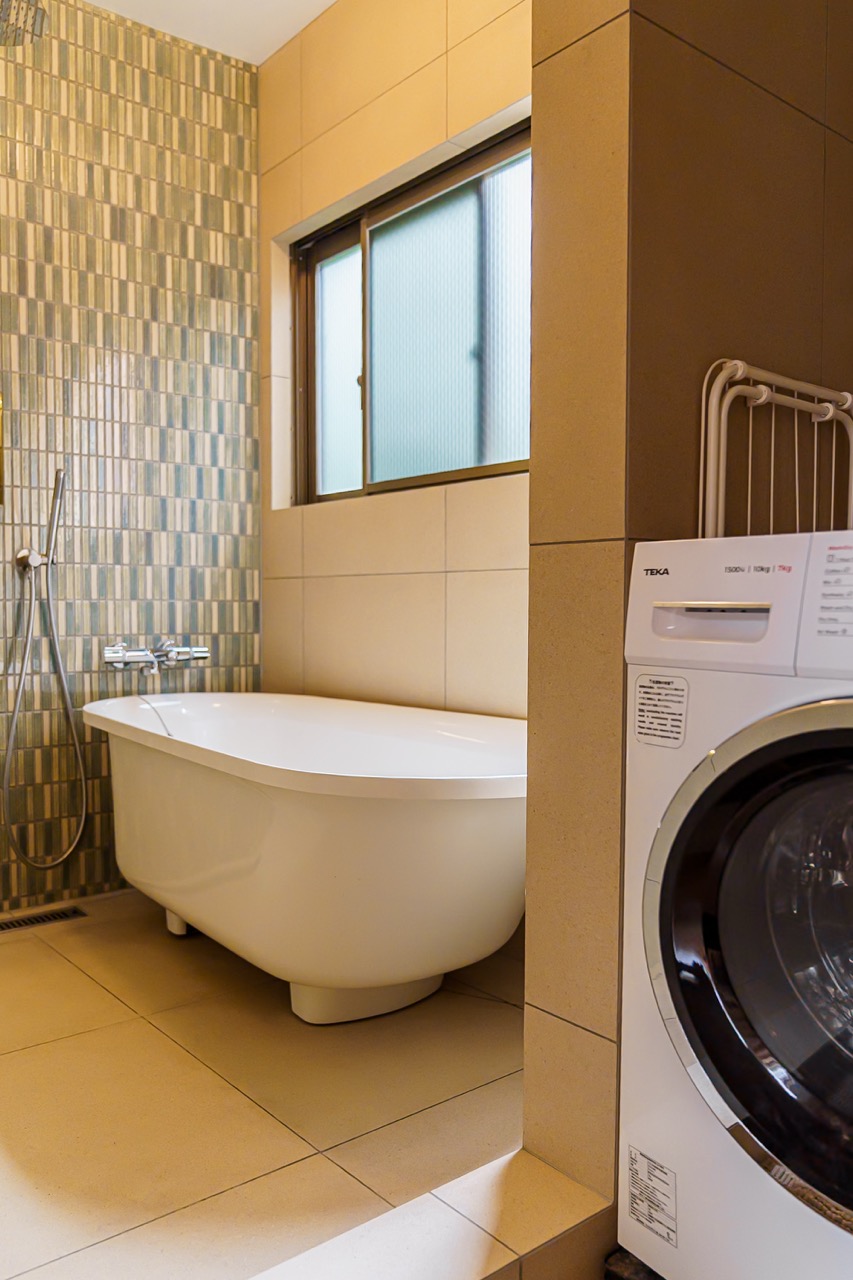
Large&Small-format kitkat tiles.
Timber ceilings.
Integrated niches.
Japanese ceramics.
A properly designed tiled bathroom has a warmth and character that's difficult to replicate with a standard prefabricated system.
That doesn't mean every project should have one.
Far from it.
But when the budget allows, it's one of the areas where great design can completely transform a home.
Japan Still Makes Some of the World's Best Tiles
One thing many foreigners don't realise is that Japan has an incredible ceramic tradition.
Last year we visited MAROKK, a Danish company that imports Japanese tiles for the Scandinavian luxury market.
Ironically, some of Japan's finest craftsmanship is often appreciated more overseas than it is domestically.
That visit made me appreciate Japanese ceramics even more.
We've since used tiles from Tajimi, one of Japan's most famous ceramic-producing regions, in several of our own renovation projects.
The craftsmanship is extraordinary.
It's a shame that so much modern housing has become standardised, because fewer homes now showcase the incredible work Japanese tile manufacturers continue to produce.
What About Microcement?
Another option that's becoming increasingly popular is microcement.
Instead of individual tiles, microcement creates one continuous waterproof surface with almost no visible joints.
It works particularly well for contemporary interiors.
Minimal.
Clean.
Warm.
It's also an excellent match for Japandi design, where texture often replaces decoration.
Like tiled bathrooms, however, it requires skilled installation.
Done poorly, problems can develop.
Done properly, the results are stunning.
Can You Buy a Used Unit Bath?
Technically, yes (yahoo auction..)
Sometimes you'll find second-hand unit baths being sold for surprisingly little money.
At first glance it sounds like a bargain.
In reality, it usually isn't.
Unlike furniture, bathrooms are designed for a very specific space.
Removing an old unit bath without damaging it takes time.
Transporting it costs money.
Storage costs money.
Installing it somewhere else often requires modifying plumbing, walls and dimensions.
Suddenly that cheap bathroom isn't cheap anymore.
We've found that reused bathrooms often become more expensive to install than simply purchasing a new one.
For that reason, we almost always recommend buying new.
Where We Recommend Spending Your Money
If there's one room we encourage clients not to cut corners on, apart from the kitchen, it's the bathroom.
You'll use it every single day.
It's also one of the most technically demanding spaces in the entire house.
Poor waterproofing can lead to leaks.
Leaks lead to mould.
Mould leads to expensive repairs.
Saving a few hundred thousand yen during construction can end up costing far more later.
Quality matters here.
How Much Should You Budget?
Every project is different.
A simple replacement unit bath might cost well under one million yen installed.
A premium Japanese system from companies like TOTO or LIXIL naturally costs more.
Once you move into custom tiled bathrooms, the budget increases again.
As a rough guideline, we often recommend allocating around ¥3 million for a high-quality bathroom as part of a larger renovation.
That allows for better fixtures, better lighting, thoughtful storage, quality materials and a space that genuinely feels luxurious rather than purely functional.
Of course, that's only a guideline.
Some bathrooms cost half that.
Others cost ten times more.
The sky really is the limit.
Our Philosophy
At JAPANDI Real Estate, we don't believe expensive automatically means better.
Some of our favourite renovations use relatively simple materials extremely well.
But we do believe in spending money where it has the biggest impact.
Bathrooms are one of those places.
Whether you choose a premium unit bath, handcrafted Japanese tiles, natural stone or microcement depends entirely on your budget and priorities.
What matters most is understanding your options before automatically selecting the cheapest solution.
The recent construction disruption reminded the industry that there is more than one way to build a bathroom.
Now that production has returned to normal, unit baths will undoubtedly remain the standard across Japan.
But if you're creating your forever home or simply want a renovation that feels truly special it is worth exploring the alternatives.
And in our experience, Sunlight, Kitchens, and Bathrooms are the best investments you can make in a Japanese renovation.
Contact Japandi Real Estate to Buy a Home & Make it Yours.
Anton Wormann is a Swedish entrepreneur, real estate investor, and founder of JAPANDI. Based in Tokyo since 2018, he has specialized in investing in and renovating undervalued Japanese properties since 2019, helping international buyers navigate Japan's real estate market.
Related Questions
Can I add another bathroom to a Japanese house?
Often, yes. It depends on plumbing access and the existing layout of the house.

Neighborhood Guide: The Best Places to Live in Tokyo
Choosing where to live in Tokyo often starts with choosing a ward. I compared five wards popular with foreigners: what each one is like, and what it actually costs to rent there in 2026.
Neighborhood Guide: The Best Places to Live in Tokyo

Tokyo Line by Line: Where to Live on the Toyoko
Choosing where to live in Tokyo typically starts with choosing a train line and a station. I spent a day visiting six stops on the Toyoko Line to see what each neighborhood is really like, and what it costs.
Tokyo Line by Line: Where to Live on the Toyoko
Why Renting in Tokyo is So Hard for Foreigners (And What to Do About It)
Fees, paperwork, guarantors, and apartments that vanish within days. What I learned trying to rent in Tokyo as a foreigner and working at a real estate company, and what to do when the standard route doesn't work.
Why Renting in Tokyo is So Hard for Foreigners (And What to Do About It)
Ready to find your home in Tokyo?
Buying and renovating a home in Tokyo can feel overwhelming from the outside — especially for international clients. We make it clear, considered, and design-led from the very first conversation.
- 01.One team guiding you through every step
- 02.A clear path from first search to final result
- 03.Homes chosen for potential, not just listings
- 04.Scandinavian design meets Japanese craftsmanship
- 05.A trusted network of architects, designers, and builders