How to Buy Property in Japan as a Foreigner
Thinking about buying property in Japan? This step-by-step guide explains everything foreign buyers need to know, from finding the right home and conducting due diligence to financing, contracts, and closing.

.webp)
No matter your nationality, buying property in Tokyo and Japan is generally straightforward.
Unlike many countries, Japan does not restrict foreign ownership of land or buildings in most cases. You do not need to be Japanese, and in many cases you do not even need to live in Japan to purchase property.
That surprises a lot of people.
The difficult part is usually not whether you are allowed to buy.
The difficult part is understanding what you are buying.
Japanese real estate comes with its own rules, documents, taxes, risks, and cultural expectations. Properties can be freehold or leasehold. Some houses may be unrebuildable. Renovation costs can be difficult to estimate. Financing can be challenging for non-residents. And many important documents are only available in Japanese.
Japan is one of the easiest countries in the world for foreigners to buy property, but not always one of the fastest.
This is generally the process we follow with clients at JAPANDI.
Step 1: Define What You're Looking For
Most buyers start by focusing on location.
In reality, the first step is understanding your goals.
Are you:
- Looking for a primary residence?
- A vacation home?
- An investment property?
- A renovation project?
- A future retirement home?
Your goals determine almost everything that follows.
A family looking for a long-term home in Tokyo will have very different priorities from someone searching for a countryside retreat or rental property.
Step 2: Understand Your Budget
The purchase price is only part of the equation.
Buyers should also budget for:
- Brokerage fees
- Registration costs
- Acquisition taxes
- Judicial scrivener fees
- Renovation costs
- Furniture and appliances
- Ongoing ownership costs
As a rule of thumb, transaction costs often add approximately 5–10% on top of the purchase price.
If you are planning a renovation, we strongly recommend budgeting for that before starting the property search. Sometimes the best property is not the most expensive one, but the one with the greatest renovation potential.
Step 3: Explore the Market
This is where many foreign buyers become overwhelmed.
There are thousands of listings online, but the listing rarely tells the full story.
A property may be:
- Unrebuildable (再建築不可)
- Leasehold rather than freehold
- Subject to road setbacks
- Located in a protected zoning district
- Require significant renovation
- Difficult to finance
At JAPANDI, we spend a significant amount of time helping buyers understand what lies behind the listing.
The cheapest property is not always the best opportunity.
And the most expensive property is not always overpriced.
Step 4: View Properties
Photos rarely tell the whole story.
Some properties feel much larger in person.
Others reveal challenges that are impossible to see online.
Sunlight, neighborhood atmosphere, road access, surrounding buildings, noise levels, and future development plans are all things we evaluate during viewings.
Many of our clients are surprised that the property they end up purchasing was not the property they originally contacted us about.
Step 5: Due Diligence
This is arguably the most important step.
Before making an offer, we review:
- Title documents
- Road access
- Zoning regulations
- Building legality
- Renovation possibilities
- Future development restrictions
- Existing defects and risks
This is often where expensive mistakes are avoided.
A cheap property is not always a good deal.
A more expensive property can sometimes be significantly better value.
Step 6: Submit a Purchase Application
Once you've found the right property, a Letter of Intent (買付証明書) is typically submitted to the seller.
This outlines:
- Purchase price
- Desired closing date
- Financing conditions
- Other terms
Negotiations may follow before an agreement is reached.
In competitive situations, the strongest offer is not always the highest offer.
It is often the offer most likely to close.
Step 7: Sign the Purchase Agreement
Once terms have been agreed, the formal purchase contract is signed.
Prior to signing, buyers receive a detailed explanation of the property and transaction from a licensed real estate agent. This document is known as the Important Matters Explanation (重要事項説明).
For foreign buyers, this is one of the most important documents in the process.
At the time of signing, buyers will typically pay a deposit, often between 5% and 10% of the purchase price.
This deposit demonstrates to the seller that the buyer is serious and committed to completing the transaction.
In most cases, if the buyer decides to walk away from the transaction without a contractual reason, the deposit is forfeited and retained by the seller.
For this reason, due diligence should be completed before signing whenever possible.
A Note on Escrow and Digital Contracts
Foreign buyers are often surprised to learn that Japan's transaction process differs significantly from countries such as the United States, Canada, Australia, and parts of Europe.
Escrow is generally not a standard part of residential real estate transactions in Japan.
Instead, buyers and sellers typically rely on the brokerage companies, judicial scriveners, banks, and the legal framework surrounding the transaction.
Closing is usually completed in a single meeting where funds are transferred, ownership is registered, and the keys are handed over.
Another surprise is that Japan can still be remarkably traditional when it comes to paperwork.
While digital contracts and online identity verification are becoming more common, some sellers, brokers, banks, and service providers still prefer physical documents, handwritten signatures, and in-person meetings.
It is not unusual for foreign buyers to assume that a property can be purchased entirely online, only to discover that certain parts of the process may still require original documents or face-to-face meetings.
Fortunately, this is changing rapidly, but buyers should not assume that every seller or institution will accept platforms such as DocuSign or fully digital contract execution.
Step 8: Complete Financing
If financing is involved, this is usually finalized after the contract is signed.
For residents of Japan, mortgage options can be surprisingly attractive.
For non-residents, financing is more limited but still possible in certain situations.
The right lender often depends on your nationality, residency status, income source, and the property itself.
One thing many buyers don't realize is that a cash offer is often viewed more favorably by sellers than a financed offer.
The reason is simple: certainty.
When a buyer requires financing, there is always a risk that the bank may ultimately reject the loan application. If that happens, the transaction may be delayed or cancelled entirely.
A cash buyer removes that uncertainty.
For a seller, a slightly lower cash offer can sometimes be more attractive than a higher offer that depends on bank approval.
Convenience, speed, and certainty often matter just as much as price.
This is particularly true for unique properties, older houses, akiyas, and properties that may be difficult to finance.
Step 9: Closing and Ownership Transfer
On closing day, funds are transferred, ownership is registered, and the keys are handed over.
The property is now yours.
Congratulations.
You're officially a property owner in Japan.
Unlike some countries, where the period between signing and closing can stretch for months, Japanese transactions are generally straightforward once financing and documentation have been completed.
Step 10: Make It Yours
This is where our favorite part begins.
Many properties in Japan have incredible potential but require vision.
Some need a simple cosmetic refresh.
Others require a complete renovation.
Whether it's a Tokyo apartment, an old countryside house, or an unrebuildable property with hidden potential, the goal remains the same:
Create a home that reflects the way you want to live.
Because buying a property is only the beginning.
The real journey starts after you receive the keys.
Final Thoughts
Buying property in Japan is often much easier than people expect.
The challenge is not the paperwork.
The challenge is understanding the opportunities and risks before you commit.
The right property can be one of the best decisions you'll ever make.
The wrong property can be difficult and expensive to fix.
That's why local knowledge matters.
And that's exactly why we started JAPANDI.
Buy a Home. Make It Yours.
Anton Wormann is a Swedish entrepreneur, real estate investor, and founder of JAPANDI. Based in Tokyo since 2018, he has specialized in investing in and renovating undervalued Japanese properties since 2019, helping international buyers navigate Japan's real estate market.
Related Questions
Can foreigners own land in Japan?
Yes. Foreigners have the same land and property ownership rights as Japanese citizens. There are no nationality restrictions on owning real estate in Japan.
Do I need a visa to buy property in Japan?
No. Property ownership and residency are completely separate in Japan. You do not need a Japanese visa to own real estate.
What documents do I need to buy a house in Japan?
Cash buyers usually only need identification and proof of funds. For a mortgage, banks also ask for income documents, tax returns, visa information, and other financial records. Having your financial documents ready in advance can significantly speed up the process.
How much down payment do I need to buy in Japan?
It depends on your residency status, the bank, and the property. Japanese residents can sometimes borrow close to 100% of the purchase price, while overseas buyers often need a larger down payment (頭金) of around 30–50%.
Can I get a mortgage in Japan as a foreigner?
Yes. Permanent residents can often access mortgage rates between 1–2%, depending on their situation. Overseas buyers can still obtain financing in some cases, though larger down payments and higher interest rates are common. We help clients understand what options may be available to them.

Neighborhood Guide: The Best Places to Live in Tokyo
Choosing where to live in Tokyo often starts with choosing a ward. I compared five wards popular with foreigners: what each one is like, and what it actually costs to rent there in 2026.
Neighborhood Guide: The Best Places to Live in Tokyo

Tokyo Line by Line: Where to Live on the Toyoko
Choosing where to live in Tokyo typically starts with choosing a train line and a station. I spent a day visiting six stops on the Toyoko Line to see what each neighborhood is really like, and what it costs.
Tokyo Line by Line: Where to Live on the Toyoko
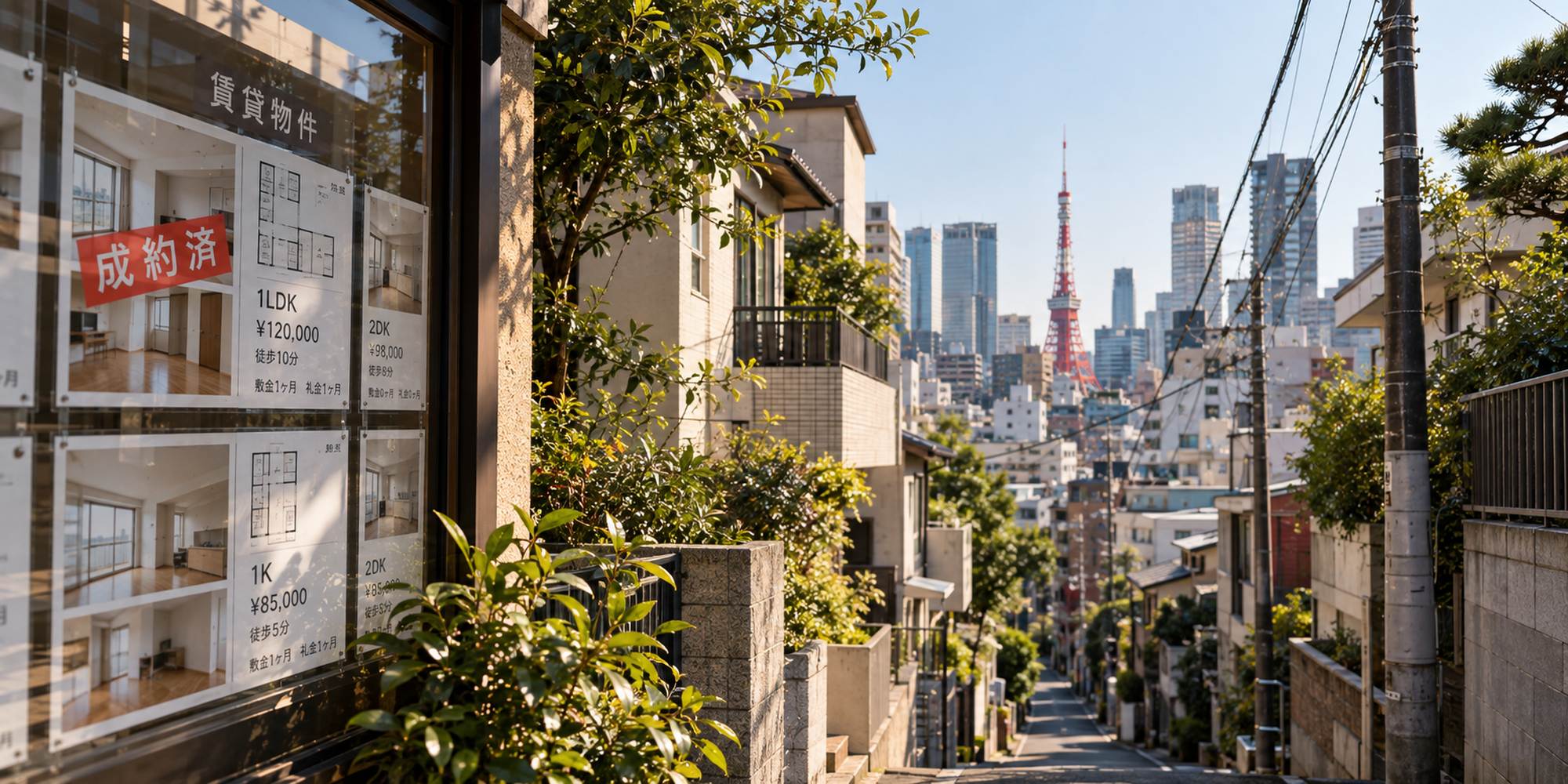
Why Renting in Tokyo is So Hard for Foreigners (And What to Do About It)
Fees, paperwork, guarantors, and apartments that vanish within days. What I learned trying to rent in Tokyo as a foreigner and working at a real estate company, and what to do when the standard route doesn't work.
Why Renting in Tokyo is So Hard for Foreigners (And What to Do About It)
Ready to find your home in Tokyo?
Buying and renovating a home in Tokyo can feel overwhelming from the outside — especially for international clients. We make it clear, considered, and design-led from the very first conversation.
- 01.One team guiding you through every step
- 02.A clear path from first search to final result
- 03.Homes chosen for potential, not just listings
- 04.Scandinavian design meets Japanese craftsmanship
- 05.A trusted network of architects, designers, and builders