Too Many Japanese Trees, Not Enough Timber?
Japan has more forest than most countries on Earth, so why do they so heavily rely on imported wood?

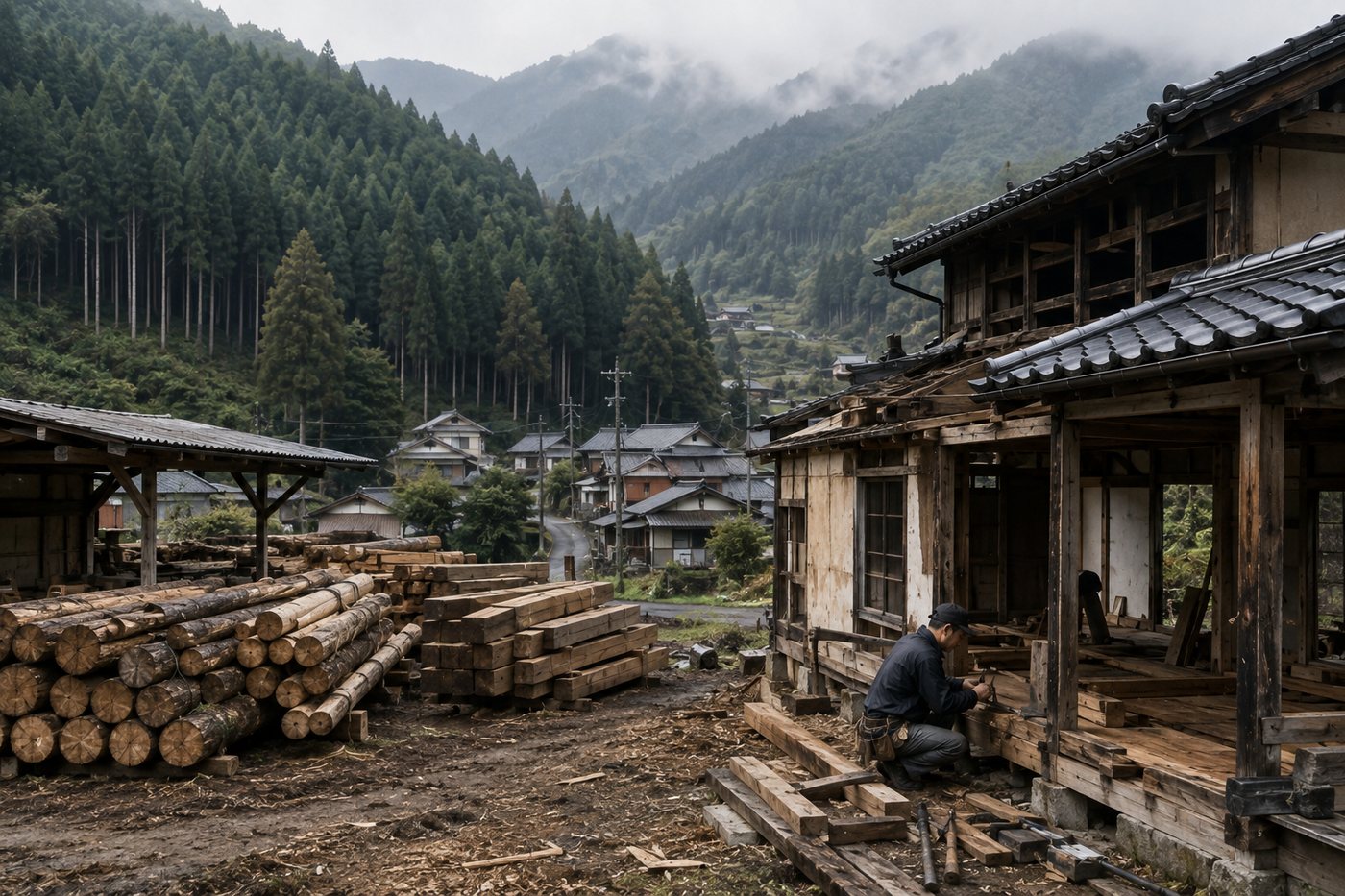
Too Many Trees, Not Enough Timber?
Why Japan's forests don't always give it the wood it needs to build and fix its houses
Japan has more forest than almost any other country. So why does so many renovation quotes include imported wood?
A single rotten beam in an akiya shows one of Japan's biggest contradictions. The forest is right outside the village. But getting the right piece of wood out of that forest and into the wall is a whole different story.
Japan's forests cover about 25 million hectares. That's roughly two-thirds of the country. On paper, this looks like a country that should never run short of wood. About 40 percent of that forest is planted, and around 64 percent of the planted trees are now over 50 years old: old enough to cut.
If you're buying and fixing up a house here, this gap matters before you even get a quote. "Local wood" sounds like the cost-eficient, easy choice. In practice, it's often the slowest one on the job. Not knowing why might cause your budget or timeline to slip.
Why local wood is slow, even when it's close by
A tree standing in a forest has a long way to go before it becomes a usable beam. It has to be reached, cut down, hauled out, sawn, dried, graded, and delivered. That's true anywhere in the world. But in Japan, a few things make that process especially slow.
- Steep land. Much of the forest sits on mountain slopes with few roads. Building and keeping up forest roads on that kind of terrain is slow and expensive, so a lot of standing timber is technically reachable but not worth reaching yet. Getting equipment in and logs out simply costs a lot more than on flat, well-connected land.
- Not enough workers. Japan had only 43,710 forestry workers in 2020, and about a quarter of them were 65 or older. Fewer workers means fewer harvests get done on time, and it also means the industry can't easily speed up even now that these forests are old enough to cut.
- Mills built for smaller logs. Many sawmills aren't set up for the bigger logs coming from these now-mature forests. Upgrading equipment costs money that a lot of smaller mills haven't been able to spend, so drying and processing a log can still take weeks.
- Land split among many small owners. About 690,000 households own forestland in Japan, and 88 percent of them own less than ten hectares. These plots are often scattered, and owners may live far away and barely know what's on their own land, since it's often something they inherited. Getting one harvest done can mean tracking down several owners just to agree on where the boundaries are and how to reach the trees.
Put it all together, and here's what it means. A standard, common size of local timber can move about as fast as anything else on the market. But anything unusual has to be found, cut, and processed on the spot, which takes time no matter how close the forest is. Imported wood comes from a system built to keep standard sizes ready and waiting on a shelf. Local wood, outside of those standard sizes, usually doesn't have that option at all.
Why imports filled the gap
After World War II, Japan needed wood fast, for rebuilding homes and cities. The government planted huge areas of fast-growing trees, mainly sugi (Japanese cedar) and hinoki (Japanese cypress), to build up a steady wood supply for the future.
The trees grew, but the market moved elsewhere. Imported wood became cheaper and easier to plan around, with standard sizes and steady delivery times. Japan's wood self-sufficiency rate dropped to just 18.8 percent by 2002, and has only climbed back to 43.0 percent by 2023. The problems above (roads, workers, mills, and land ownership) are a big reason that gap never fully closed.
How much of this actually affects your renovation
Not every part of a renovation runs into this problem. Most of the wood used, framing for new walls, blocking, small support pieces, is standard lumber. And standard sizes are exactly where both local and imported wood keep up fine.
The problem shows up when a job needs something outside the standard range: a beam size mills don't keep in stock, wood that has to match a structural piece that's staying in place, or wood that will stay visible in the finished room instead of hidden behind a wall. That's usually a small part of the total wood used in a renovation. But it's often the most important part, the part you can't just swap for whatever's on the shelf. That's exactly why it's worth asking about early, instead of finding out once the wall is already open and the schedule is already running.
Final Thoughts
Japan doesn't need to grow more trees. It needs the whole system, owners, forestry workers, roads, mills, and carpenters, working together, with cutting followed by real replanting and long-term care. The forest was never really the problem. Getting what's already in it to a job site, on time, is.
Knowing this before you get a quote helps you budget and plan realistically. It's especially useful if your renovation involves an older structural frame, where matched or specialty timber can quietly extend both the cost and the timeline.
If you're thinking about buying or renovating a home in Tokyo, JAPANDI Real Estate is here to help, from finding the right property to guiding you through the renovation process from start to finish.
Axel Westholm is a Swedish student of forestry, wood technology, and sustainability, with a background in East Asian culture, history, and language. He is currently an intern at Japandi Real Estate.

Neighborhood Guide: The Best Places to Live in Tokyo
Choosing where to live in Tokyo often starts with choosing a ward. I compared five wards popular with foreigners: what each one is like, and what it actually costs to rent there in 2026.
Neighborhood Guide: The Best Places to Live in Tokyo

Tokyo Line by Line: Where to Live on the Toyoko
Choosing where to live in Tokyo typically starts with choosing a train line and a station. I spent a day visiting six stops on the Toyoko Line to see what each neighborhood is really like, and what it costs.
Tokyo Line by Line: Where to Live on the Toyoko
Why Renting in Tokyo is So Hard for Foreigners (And What to Do About It)
Fees, paperwork, guarantors, and apartments that vanish within days. What I learned trying to rent in Tokyo as a foreigner and working at a real estate company, and what to do when the standard route doesn't work.
Why Renting in Tokyo is So Hard for Foreigners (And What to Do About It)
Ready to find your home in Tokyo?
Buying and renovating a home in Tokyo can feel overwhelming from the outside — especially for international clients. We make it clear, considered, and design-led from the very first conversation.
- 01.One team guiding you through every step
- 02.A clear path from first search to final result
- 03.Homes chosen for potential, not just listings
- 04.Scandinavian design meets Japanese craftsmanship
- 05.A trusted network of architects, designers, and builders