How Much Is a House in Japan? Average Prices in 2026
What does a house cost in Japan in 2026? National averages, Tokyo prices by ward, new vs used, and what ¥50M to ¥200M buys.

The Short Answer
About ¥27.8 million (US$177,000) for an average used house in Japan, and ¥42.2 million (US$268,000) for a new one (fiscal 2025). In Tokyo’s 23 wards, multiply by almost three: the average used house sold for ¥74.9 million (US$477,000) in July 2026.
We’ve seen both ends of that range up close. Anton bought an abandoned farmhouse for US$15,000 and the US$25,000 Waterfall House, and renovated both on our YouTube channel. In Tokyo, we bought and renovated a US$350,000 apartment. All three are “a home in Japan”. What you pay depends almost entirely on where it is, how old it is, and how much you’re willing to fix.
Below are the latest averages for Japan and Tokyo, what different budgets actually buy, and why some houses cost less than a used car. Every figure is dated and sourced, and we update this page twice a year.
Average House Price in Japan in 2026
The most useful national figures come from the Japan Housing Finance Agency’s yearly survey of Flat 35 mortgage buyers. It only covers people who used that loan, so read it as a solid sample, not a full census. In fiscal 2025 (April 2025 to March 2026), every home type got more expensive.
Average housing price in Japan by home type, fiscal 2025 (Japan / Greater Tokyo)
- Used house: ¥27.8M (US$177k) / ¥34.6M (US$220k)
- Used apartment: ¥36.0M (US$229k) / ¥40.9M (US$261k)
- New ready-built house: ¥42.2M (US$268k) / ¥48.4M (US$308k)
- New custom house including land: ¥53.1M (US$338k) nationally
- New apartment: ¥58.8M (US$375k) nationally
Two things stand out. A used house costs about a third less than a new one, and Greater Tokyo is only around 14 to 24% above the national average on these figures. That second figure needs context, because “Greater Tokyo” here includes Saitama, Chiba and Kanagawa. Inside the 23 wards, prices are on another level, as the next section shows.
What about the median house price in Japan? No official source publishes a national median for house sales. Averages are pulled up by expensive city homes, so the typical house outside the big cities costs less than the figures above. Land prices tell the same story: in the September 2026 land price survey, residential land rose 1.0% nationally but 8.7% in Tokyo’s 23 wards.
House Prices in Tokyo
The best source for real Tokyo house prices is REINS, the database licensed agents use to record actual sales. These are closed deals, not asking prices.
Tokyo house prices, closed sales in July 2026 (REINS)
- Tokyo 23 wards: used house ¥74.9M (US$477k), 95 m² on 82 m² of land, 25 years old. Used apartment ¥77.6M (US$494k), 56 m², 26 years old, ¥1.36M per m².
- Tokyo Tama area: used house ¥43.4M (US$276k), 104 m² on 143 m² of land. Used apartment ¥38.0M (US$242k), 65 m², ¥584,000 per m².
- Greater Tokyo: used house ¥39.3M (US$250k). Used apartment ¥52.7M (US$336k), ¥842,000 per m².
REINS works out the price per m² for each sale and then averages it, so it won’t exactly match the average price divided by the average size.
Notice that in the 23 wards the average used apartment now costs more than the average used house, even though the house is about 70% bigger. We wrote a whole article on why a Tokyo condo can cost more than the house next door.
You may also see much higher numbers in the news. Tokyo Kantei reported ¥126.3 million for a 70 m² used apartment in the 23 wards in September 2026, and ¥177.9 million in the six central wards. Those are asking prices for a standardized 70 m² unit, so they run above REINS sale prices. They also show the direction: after 25 months of increases to a record in May 2026, asking prices in the 23 wards fell four months in a row, and in the six central wards five months in a row. New apartments are higher still, with an average of ¥137.8 million in the 23 wards in fiscal 2025.
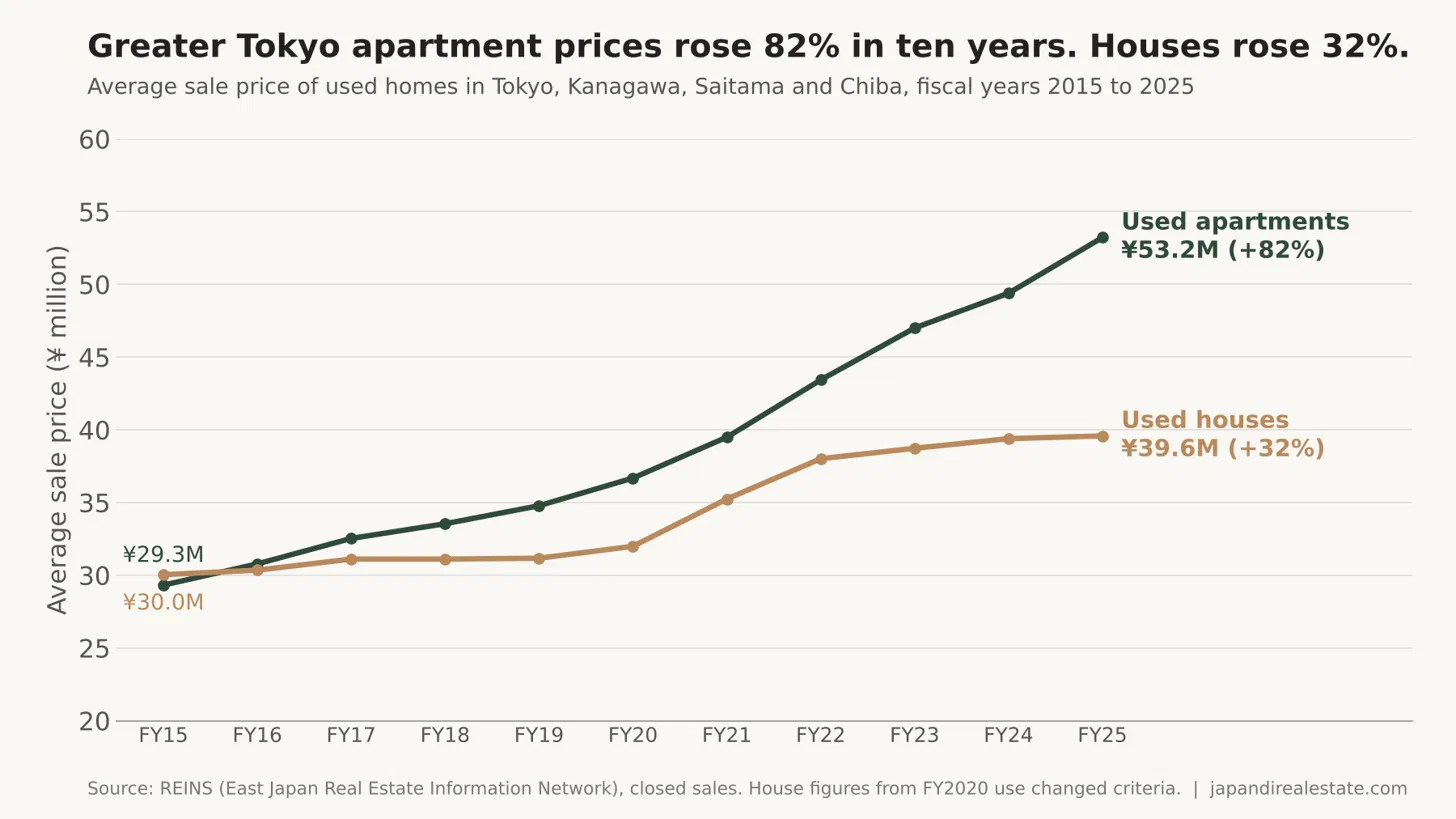
Over ten years, apartments have pulled away from houses. Across Greater Tokyo, the average used apartment sold for 82% more in fiscal 2025 than in fiscal 2015, while the average used house rose 32%.
Price per m² by Neighborhood
Land is most of what you pay for in Tokyo, so land prices are the clearest way to compare areas. These are the official 2026 residential land prices for the wards we work in most.
Average residential land price per m² by ward, 1 January 2026 (official land price publication)
- Setagaya: ¥779,900 per m², +7.0% vs 2025
- Meguro: ¥1,404,500 per m², +13.7% vs 2025
- Shibuya: ¥1,874,100 per m², +11.0% vs 2025
- Minato: ¥3,013,700 per m², +16.6% vs 2025
- All 23 wards: ¥856,400 per m², +9.0% vs 2025
In the September 2026 land price survey, residential land rose in all 23 wards, led by Minato at +16.3%. If you are still choosing an area, start with the best places to live in Tokyo.
New vs Used Houses
Nationally, a new ready-built house cost ¥42.2 million in fiscal 2025 and a used house ¥27.8 million. The gap comes from how Japan values buildings. A wooden house is treated as having almost no value after 20 to 25 years, so on an older house you are mostly paying for the land.
For buyers this is often good news. A well-built house from the 1990s or 2000s, in a good area, can cost little more than the land under it. We explain when that makes sense in why an older home in Tokyo might be the smarter buy. One rule we always follow: check whether the building meets the 1981 earthquake standard before you look at anything else.
Houses vs Apartments
Outside the big cities, houses are the norm and usually the cheaper option. In central Tokyo it is the other way around. Apartments near stations sell at a premium, while houses on narrow streets or older plots can be surprisingly affordable per m².
Older apartments have also held their value better than many expected, especially in good buildings near stations.
Why Some Houses in Japan Are So Cheap
You have probably seen headlines about houses in Japan for under US$50,000. They exist, and there are three main reasons.
- Depreciation. As above, an old wooden house can be valued at close to zero.
- Empty houses (akiya). Japan had about 9 million vacant homes in 2023, 13.8% of all housing, according to the Ministry of Internal Affairs and Communications. About 3.85 million of them were not for sale or rent at all, often in rural towns with shrinking populations.
- Non-rebuildable plots. In Tokyo, the cheapest houses are often on land without proper road access, where the house cannot legally be rebuilt. They can sell 50 to 80% below a normal plot. Read what unrebuildable land means in Japan before you consider one.
A cheap price is rarely the full cost. We have renovated several of these houses ourselves, and the renovation can easily cost more than the house did. Our renovation cost guide shows real numbers from our projects.
What Your Budget Buys in Tokyo: ¥50M, ¥100M, ¥200M
Using the July 2026 REINS average of about ¥1.36 million per m² for used apartments in the 23 wards, here is a rough guide. Real prices vary a lot by station, building age and floor.
- ¥50M (US$318k): a used apartment of about 35 to 40 m², usually a one-bedroom, with more space in the outer wards. The same money buys a used house in the Tama area, or an older house on a small plot in the outer wards.
- ¥100M (US$637k): a used apartment of about 70 to 75 m², a two or three-bedroom family unit. Or a used house in many residential wards such as Setagaya.
- ¥200M (US$1.27M): around 150 m² at the 23-ward average, or a 70 m² apartment in the central wards. Or a house in Meguro.
Costs on Top of the Price
Budget for more than the purchase price. Closing costs, including the agent fee, registration taxes and the judicial scrivener, typically add about 6 to 10% to the price. We break them down line by line in the actual closing costs on a ¥100 million house in Tokyo.
After you buy, you pay property tax every year: fixed asset tax and city planning tax. Foreigners can buy property in Japan with no visa or residency, and our guide on how to buy a house in Japan as a foreigner walks through the full process.
Looking for a Home in Tokyo?
Averages are a starting point, but every street in Tokyo is priced differently. We are a licensed, English-speaking agency in Sangenjaya, and we can show you what your budget buys in the areas you like, including homes that never reach the big portals. Book a consultation and tell us what you are looking for.
We update these numbers twice a year. Subscribe to our newsletter on the side of this page to get the next update, along with new listings and renovation stories.
Coming to Tokyo to view properties? Stay in one of our renovated homes at Japandi Houses and get a feel for the neighborhoods before you buy.
JAPANDI - Buy a Home. Make it Yours.
FAQ
How much is a house in Japan on average?
A used house bought with a Flat 35 mortgage cost ¥27.8 million on average in fiscal 2025, and a new ready-built house ¥42.2 million. The average used house in Tokyo’s 23 wards costs almost three times as much.
How much does a house cost in Tokyo?
The average used house in the 23 wards sold for ¥74.9 million in July 2026 (REINS), with about 95 m² of floor space on 82 m² of land. In the Tama area of western Tokyo, the average was ¥43.4 million.
Are house prices in Japan going up?
In Tokyo, yes. Residential land in the 23 wards rose 8.7% in the September 2026 survey, and every ward rose. Nationally the rise was 1.0%, and many rural areas are still falling.
What is the median house price in Japan?
No official source publishes a national median for house sales. The closest figures are averages: in fiscal 2025, a used house bought with a Flat 35 mortgage cost ¥27.8 million and a new ready-built house ¥42.2 million. The typical house outside the big cities costs less than that, because expensive city homes pull the average up.
Is it better to buy a house or an apartment in Tokyo?
It depends on how you want to live. Apartments are easier to buy and finance near stations, while houses give you more space and land for the money. Many of our clients compare both before deciding.
Sources
Exchange rate used: about ¥157 = US$1 (26 October 2026).
- Japan Housing Finance Agency, Flat 35 user survey, fiscal 2025
- REINS (East Japan Real Estate Information Network), Monthly Market Watch summary report, July 2026
- Tokyo Kantei, used apartment asking prices, September 2026, via Kyodo
- Real Estate Economic Institute, Greater Tokyo new apartment market, fiscal 2025
- MLIT, prefectural land price survey, September 2026
- Ministry of Internal Affairs and Communications, 2023 Housing and Land Survey
- Tokyo Metropolitan Government, 2026 official land prices for Tokyo, summary (ward averages, as of 1 January 2026)
- REINS, Greater Tokyo market report for fiscal 2025 (10-year series)
Axel Westholm is a Swedish Forestry- and Wood Engineer fluent in Japanese, English and Swedish, supporting Real Estate operations and Content Creation.
Related Questions
Can foreigners buy property in Japan?
Yes. Japan has no general law that stops foreigners from buying land or houses, and you don’t need a visa or residency. Buyers who live outside Japan must report the purchase to the Ministry of Finance within 20 days. Our guide on how to buy a house in Japan as a foreigner walks through each step.
Can I get a mortgage in Japan as a foreigner?
Yes. Permanent residents can often access mortgage rates between 1–2%, depending on their situation. Overseas buyers can still obtain financing in some cases, though larger down payments and higher interest rates are common. Older houses are often harder to finance, which we explain in why Japanese banks dislike old houses. We help clients understand what options may be available to them.
How much are closing costs when buying property in Japan?
Closing costs generally range from 6–10% of the purchase price, depending on the property and financing. For our clients buying around ¥100 million, they typically come to about 6–7%. See our full breakdown of closing costs on a ¥100 million Tokyo home.
Should I buy a house built before 1981 in Japan?
Not necessarily. Many older homes are excellent, but they require careful inspection and can be more difficult to finance because they predate the 1981 earthquake standard. We explain when an older home can still be the smarter buy.

Why Are Japanese Houses So Cold? (And How to Fix It)
Thin walls, single glass in aluminum frames and almost 45 years of voluntary insulation rules. Why Japanese homes are so cold in winter, and what you can do about it.
Why Are Japanese Houses So Cold? (And How to Fix It)

Why Japanese Banks Dislike Old Houses (and Why You Can’t Get a Loan)
You found the perfect old house in Japan, and the bank said no. We explain why Japanese banks dislike old houses, why foreigners struggle to get loans, and what you can do instead.
Why Japanese Banks Dislike Old Houses (and Why You Can’t Get a Loan)
Rental Yields in Japan: Why Cheaper Properties Offer Higher Returns
Japan’s housing market works the other way around from most countries. Here is what rental yields really look like in Tokyo, Osaka, Nagoya and the countryside, and why rent, not price growth, is the reason to buy.
Rental Yields in Japan: Why Cheaper Properties Offer Higher Returns
Ready to find your home in Tokyo?
Buying and renovating a home in Tokyo can feel overwhelming from the outside — especially for international clients. We make it clear, considered, and design-led from the very first conversation.
- 01.One team guiding you through every step
- 02.A clear path from first search to final result
- 03.Homes chosen for potential, not just listings
- 04.Scandinavian design meets Japanese craftsmanship
- 05.A trusted network of architects, designers, and builders